Follow Every Bill Through Its Renewal Cycle
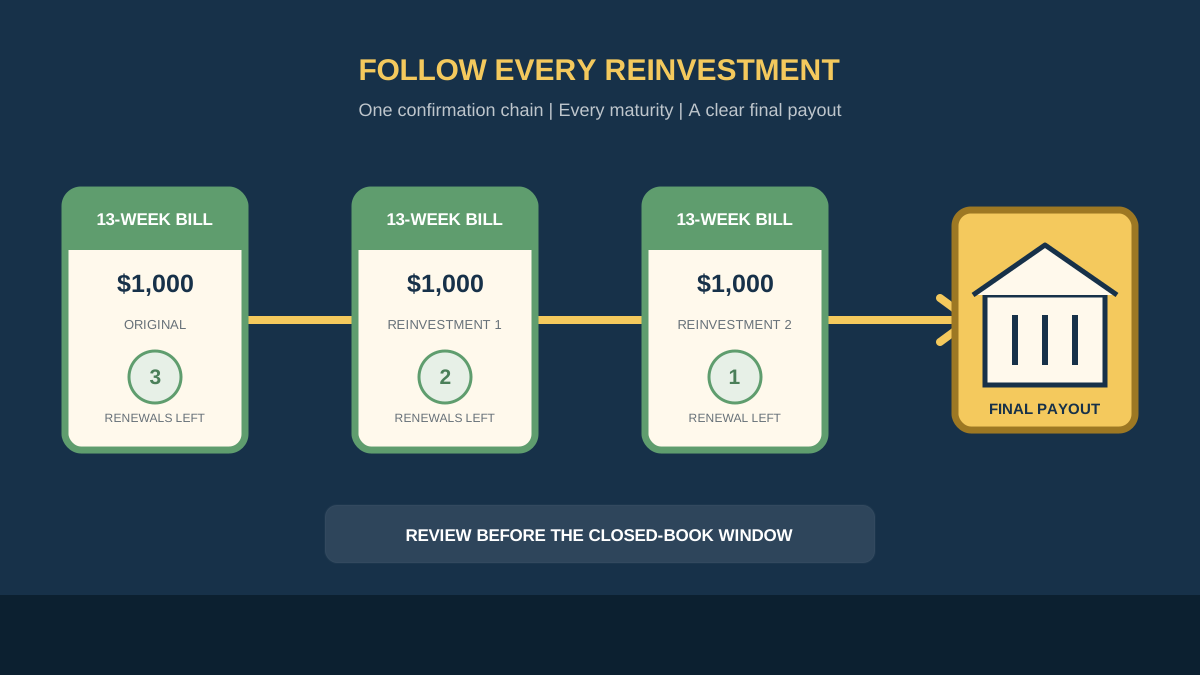
T-Bill reinvestment uses the proceeds from a maturing Treasury bill to purchase another bill of the same term. A 13-week bill rolls into a new 13-week bill, keeping the principal on a repeating cycle.
The new bill’s auction price determines the cash adjustment. When the new purchase price is below the maturing face value, TreasuryDirect sends the difference to the selected payment destination. When extra funds are required, TreasuryDirect draws the difference from the designated source.
A reinvestment tracker connects the original holding to each renewal and shows the next expected maturity. That history makes a long rollover chain feel like one continuing position.
Know the TreasuryDirect Reinvestment Limits
TreasuryDirect allows bill reinvestments to be scheduled across a period of up to two years. The maximum count varies by term because shorter bills renew more frequently.
- 4-week T-Bill 25 renewals
- 6-week T-Bill 16 renewals
- 8-week T-Bill 10 renewals
- 13-week T-Bill 7 renewals
- 17-week T-Bill 6 renewals
- 26-week T-Bill 3 renewals
- 52-week T-Bill 1 renewal
Recording the requested count at purchase time gives the ladder a clear forecast. Updating the remaining count after each rollover keeps the expected final bank return date current.
A four-week bill with 25 renewals can continue for roughly two years, while a 26-week bill reaches that span with three renewals. Both paths cover a similar horizon through different rhythms.
Plan Around the Closed-Book Window
TreasuryDirect applies a closed-book period four business days before a scheduled interest or maturity payment. During that processing window, the security’s reinvestment count, payment destination, registration, and transfer rights stay fixed.
Auction timing can bring the decision deadline forward. Reviewing each bill a full week before maturity creates a comfortable planning rhythm and leaves time to confirm the current TreasuryDirect status.
A calendar reminder can mark three moments: the review day, the closed-book boundary, and the maturity date. The tracker can then show which holdings still have an open decision window.
Choose Reinvestment or Bank Payout With Purpose
Reinvestment keeps a funded rung moving forward and supports the ladder’s future coverage. A final payout releases principal and interest to the selected bank for current spending or another savings goal.
Labeling that purpose on the planning calendar turns each maturity into a clear action. “Renew” maintains the rung, while “pay out” prepares the cash for a known week.
Bank destinations deserve the same attention as renewal counts. Tracking the selected account by nickname and final four digits helps confirm where the maturity proceeds are expected to arrive.
For a complete picture, combine reinvestment tracking with the TreasuryDirect Bill Tracker. The ladder can display each renewal chain, maturity week, and payment destination together.
Make Every Renewal Visible
Import your TreasuryDirect holdings and see remaining reinvestments, maturity timing, and expected bank returns on one board.
TreasuryDirect.gov provides the current official rules and account status for every reinvestment. Review each security there before changing renewal or payment instructions.