Begin With the Weekly Cash-Flow Goal
A weekly T-Bill ladder is a group of Treasury bills with maturity dates spread across consecutive weeks. Each maturity returns principal plus interest, creating a regular opportunity to reinvest the money or send it to a bank account.
Start by choosing a target amount for each week. TreasuryDirect accepts marketable-security purchases starting at $100 and in $100 increments, so a $100, $300, or $500 weekly rung can provide a clear building unit.
Your target becomes the ladder’s basis. A 26-week ladder with a $500 basis aims for $500 of principal on each of 26 maturity weeks, producing a $13,000 principal runway when every rung is filled.
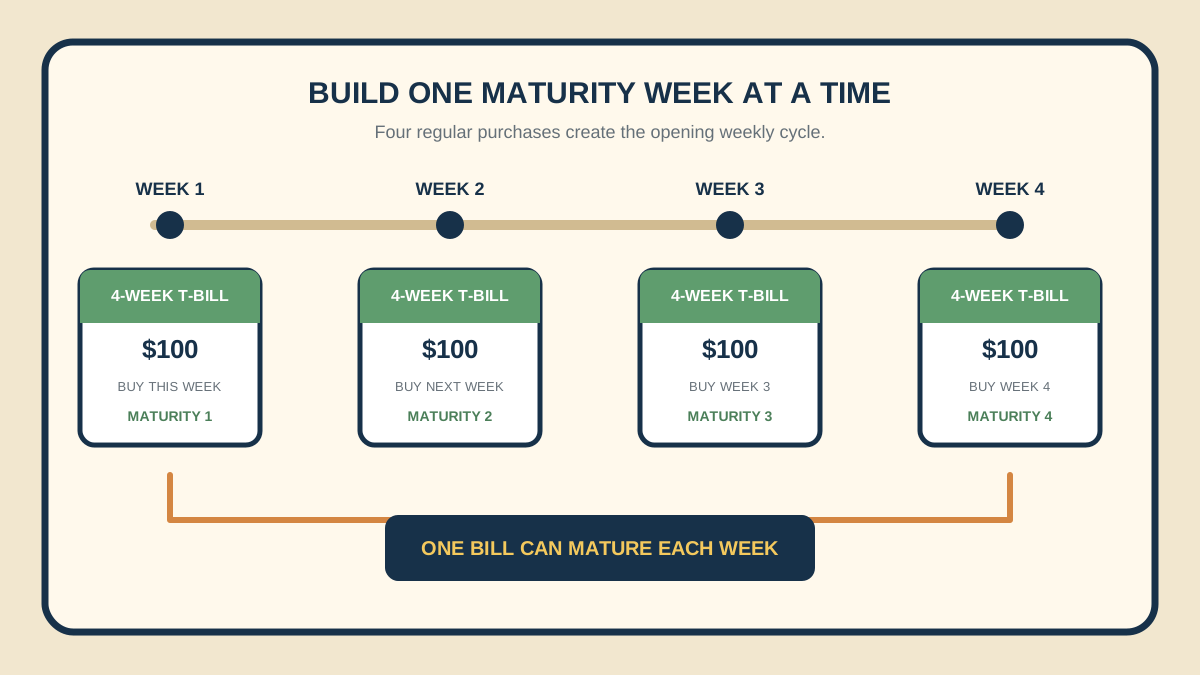
1. Establish the First Four Weeks
Four-week Treasury bills offer a simple starting cycle. Buying one bill during each weekly auction can establish four staggered maturity dates after the opening month.
Once the cycle is running, one four-week bill reaches maturity each week. Reinvesting that principal into another four-week bill keeps the four-rung pattern moving forward.
Treasury auction and issue dates follow regular cycles, with holiday adjustments on some weeks. Planning from the published issue date produces the clearest expected maturity date.
2. Extend the Maturity Runway
After the first four rungs, additional terms can lengthen the ladder. Six-week bills add nearby weeks, 13-week bills extend the schedule to roughly three months, and 26-week bills build toward a six-month reserve.
Choose purchases according to the maturity week they fill. This maturity-first approach keeps attention on the cash-flow schedule and helps each new bill strengthen an open or underfunded rung.
A color-coded ladder makes this progression easy to scan: green for the four-week shield, blue for the six-week extension, orange for the 13-week bridge, and purple for the 26-week ladder.
3. Give Every Maturity a Job
Each maturity creates a decision point. Reinvestment keeps the rung active, while a bank payout turns saved principal into available cash. A written rule for that decision makes the ladder easier to manage.
During the building stage, many savers choose reinvestment so the existing principal continues working. New weekly contributions can then fill additional rungs and increase the amount on lightly funded weeks.
During an income interruption, selected maturities can flow to the bank. A fully staggered ladder supports a sequence of weekly deposits instead of one distant lump sum.
4. Review the Ladder Every Week
A short weekly review keeps auction dates, issue dates, maturity dates, and reinvestments aligned. Check the next maturity, the next purchase, and the principal scheduled for each upcoming week.
Use a TreasuryDirect bill tracker to place holdings by maturity week and identify gaps early. The visual board can also show when several bills share one date.
Consistency builds the ladder. One planned contribution, one reviewed maturity, and one clear next move can gradually create months of organized emergency cash flow.
Place Your First Rung
Practice the steps with a Testing Ladder, or create a Live Ladder to organize Treasury bills held in your TreasuryDirect account.
Educational information for building a Treasury bill savings plan. Confirm current offering dates, terms, and account procedures through TreasuryDirect.gov.