Build Emergency Savings Around Time
A T-Bill ladder for emergency savings divides a reserve among Treasury bills that mature on different dates. Each maturity returns a portion of the saved principal plus the interest earned on that bill.
Staggering those dates can create a weekly sequence. If income pauses, each arriving maturity can support another week of expenses, much like a series of scheduled transfers from the reserve.
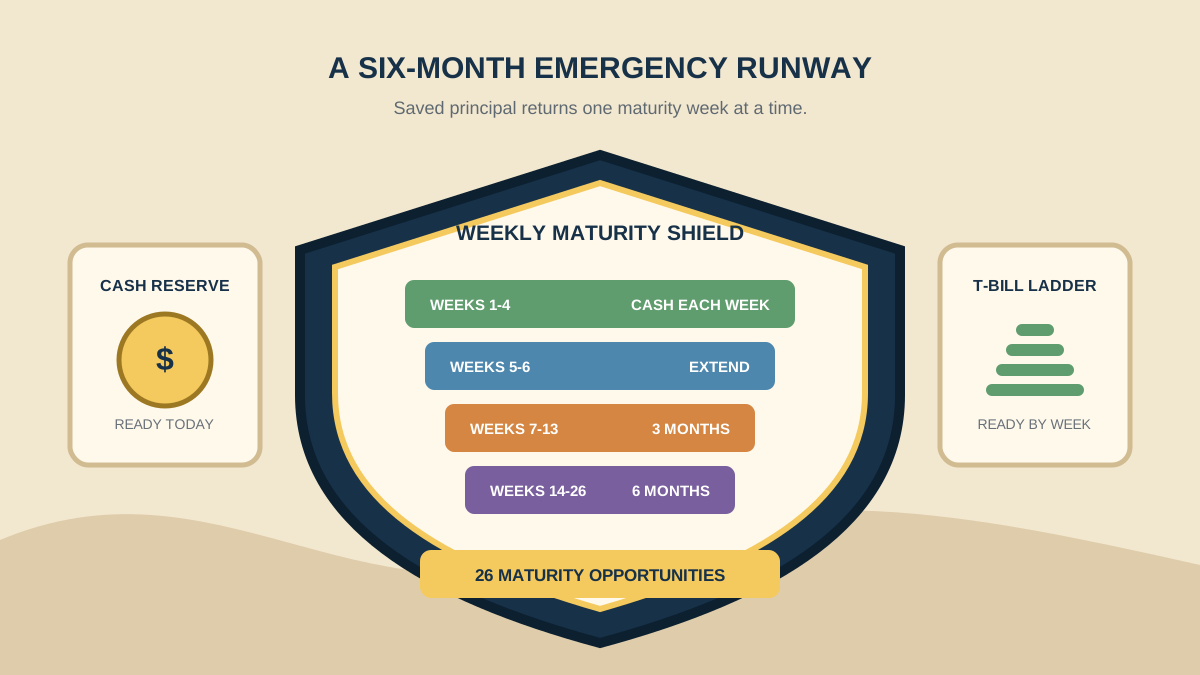
This approach gives emergency savings two useful forms: accessible cash for immediate needs and a Treasury bill runway for the weeks that follow.
Keep an Immediate-Cash Layer
An effective emergency plan starts with cash that is ready today. This layer can cover urgent repairs, deductibles, travel, or a bill due before the next Treasury maturity.
The T-Bill ladder forms the next layer. Four-week bills create an approachable first cycle, and a fully staggered schedule can bring a different bill to maturity every week.
Together, the layers balance immediate access with structure. Cash handles the opening days, while the ladder provides a planned stream for a longer interruption.
Ready for expenses that arrive today or this week.
Scheduled maturities for the weeks and months ahead.
Create a Paycheck-Replacement Target
Choose a weekly amount that reflects essential spending. A $500 basis means the ladder aims to place $500 of principal on every funded maturity week.
Four funded weeks create a one-month shield. Thirteen funded weeks approach a three-month bridge, and 26 consecutive weeks create a six-month runway.
The payments represent money you previously saved, returning on a schedule you designed. Interest adds to the result, while principal provides the core emergency support.
Save during steady-income weeks. Reinvest while the reserve grows. Receive weekly maturities when the reserve becomes useful.
Use Friction as a Savings Feature
A Treasury bill gives saved money a specific job and maturity date. That structure creates a thoughtful pause between everyday spending and the part of the reserve assigned to a future week.
Regular purchases can turn payday into visible progress. Every new card funds another rung, strengthens an existing week, or extends the runway farther across the calendar.
Treasury bills are backed by the full faith and credit of the United States, and their interest is subject to federal income tax while exempt from state and local income taxes. Current auction rates determine each bill’s return.
Grow the Reserve One Rung at a Time
A first $100 bill creates the first maturity point. Repeating the move builds the habit and teaches the auction-to-maturity cycle through practical experience.
As the reserve grows, a weekly T-Bill ladder plan can guide purchases toward consecutive weeks. A visual tracker shows funded rungs, lighter rungs, and the next useful move.
The finished ladder becomes a financial timeline: 26 weeks, 26 maturity opportunities, and a clear choice to reinvest or receive each payment.
Start Your Emergency-Savings Runway
Set a weekly basis, build the first four maturity rungs, and grow toward six months of organized cash flow.
Educational information for emergency-savings planning. Consider your expenses, liquidity needs, tax situation, and current TreasuryDirect terms when shaping your reserve.